RSS

Anticipatory GenCon 2012 post

Thanks to the scheduling gods and the gracious invitation of InD20's Larry Fettinger to let me stay at his house (thus saving 900-1000$ in hotel fees), I'll be going to Gen Con again this year. This time, however, should prove to be quite a different experience, as I'll only be in a booth for a few hours of the convention instead of 8-9 hours a day like 2011.

Coupled with the fact that I'll be arriving at Larry's on Tuesday and sharing space with prominent and promising publishers (Seth and Michael from Tasty Minstrel, Josh & Adam from Chip Theory), reviewing royalty Ryan Metzler, and Ascension Archnemeses James and Jacob McCarthy. I'll have plenty of time to play games and wander around the vendor's hall and open gaming area. While doing so, I hope to meet up with some of the people with whom I interact frequently on twitter and play some of their games as well as some of the big name games that will be released at the convention. Listed below are but a few of the many games and things I hope to play and accomplish at this year's convention as well as the ones Scott hopes I bring back for us to play together.

GAMES TO BE RELEASED AT GENCON:


#1: Smash Up -- My main goal at conventions is not simply to pick up the hottest games for the sake of reviewing them, moreso they serve as a place to buy games that my wife and/or family can play together. Fortunately, AEG's Smash Up fits squarely into both categories. With it's intriguing "Shuffle building" mechanic, players can take a number of popular gaming tropes, combine them, and actively work to score bases and set off devious combos in hopes of scoring the most points. No, it doesn't look incredibly deep, but it does look insanely fun, and that's the most important thing in a game to me. 

#2: Seasons - The visibility of this game seems to be growing by leaps and bounds (and hopefully, some of that visibility has come b/c of my efforts to tell people about it), and I think this beautiful title by Asmodee might end up being a sleeper hit of the convention. Using beautiful art from Xavier Durin, Seasons takes the resource management of Magic: the Gathering and the drafting of 7 Wonders and mashes them together with a dice mechanism that dictates the progression of time and duration of the game itself. I played a pre-production copy of the game at Origins and came away VERY impressed, so I can't want to make it a part of my collection. 


#3: Dominion: Dark Ages -- Like many other tens of thousands of people around the world, I'm a Dominion addict; and this latest iteration from Donald X. has me salivating like Pavlov's dogs at any hint of a preview card or insider information. To date, we just know that the focus of the expansion will be upgrading and trashing. I was a big fan of the 3 card in Ascension that let you manipulate things in the graveyard/Void, so I'm waiting with bated breath to see what kinds of shenanigans can be pulled with these new kingdom cards and how the new Ruins card impacts play. I am not, however, looking forward to schlepping my big 3200-count box containing the entirety of Dominion collection through Hall D.


#4: Android: Netrunner -- (Scott) My gaming history goes back to the early days of collectible card games.  One of my favorites from back then was Netrunner.  I especially loved the cyberpunk-ish theme and I loved the two distinct play styles of the Runners and the Corporation.  When I recently heard that Fantasy Flight was going to bring back Netrunner, I was extremely excited.  I was a little apprehensive about it being rethemed into the Android universe.  However, the Twilight Imperium reimagining of Dune into Rex seems to have worked well, so I have the utmost faith that Fantasy Flight has not hurt my baby.  Also, I hope that it's successful enough that we see more than 2 sets for this edition.

#5 Aeroplanes: Aviation Ascendant  -- (Scott) Clunky title aside, we have a new economic game exploring the early 1900s by Martin Wallace, hooray!  Actually, Wallace's Automobile has been a favorite of mine since its release a couple years ago.  Aeroplanes covers a similar time frame, but apparently is a bit lighter and more forgiving than Automobile.  Hopefully that will help it come to the table a bit more often than Automobile does.

#6 Africana - (Scott) Africana is the new game by Michael Schacht, a designer whose games I've greatly enjoyed over the years (Zooloretto, China).  In Africana, players are going to be travelling around Africa, going on expeditions in order to gain enough money to set off on a grand adventure.  I'm intrigued by the "Adventure book" mechanic, which Schacht borrows from his own Valdora.  Sounds like it will be a very fun game.

Other published games I'm looking forward to playing
  • Farmageddon
  • Alien Frontiers: Factions
  • Morels 
  • Sentinels of the Multiverse: Infernal Relics
  • Viva Java
  • Libertalia
  • Sheepland
  • Libertalia
  • Nefarious
  • Chicken Casesar
  • If I'm Going Down
  • Timeline: Discoveries
  • 7 Wonders: Cities
UNPUBs ON THE RADAR:

#1: Mars Needs Mechanics -- I met Ben Rosset briefly at Origins this year, and he seemed like a bright, passionate designer with whom I'd like to speak more. I, unfortunately, didn't get to play his game, Mars Needs Mechanics, but made a mental note to do everything in my power to play it at GenCon. MnM, from what I could deduce, is a set collection game that uses timing effects in order to allow players to build combos and be the most successful engineer. As a lover of engine-building games, the ability to build an engine (both literally and figuratively) in this game has be eagerly awaiting my turn to play it. 


#2: Swinging Jivecat Voodoo Lounge -- Loyal readers of this site will know that this game has been my White Whale since Origins 2011, when I fist saw it. I was within feet of multiple playthroughs of it at Origins this year, but never got the opportunity to play myself (though getting to play Princes of the Dragon Throne and Forge were pretty sweet consolation prizes) . Nonetheless, I didn't get to touch the martini glasses or the skulls, or the plastic monkeys... and that makes me a sad panda. In SJVL, players are hepcats in the club scene of the late 50s, and through careful usage of the cards they are dealt/acquire, they progressively build cliques in the four areas on the Lounge. It's abstract-y to a point, but still maintains a hilarious theme, (i.e. it's right up my alley.)


#3: King of Tokyo: Power Up -- Though I'm sad that the expansion to one of my favorite games of 2011 got pushed back from GenCon to Essen, I am pretty pumped that IELLO will have demoable copies at their booth. For those who haven't been obsessively following the news about this expansion, Richard Garfield has appeased the throngs of players clamoring for individual character powers. In Power Up, characters may activate a specific character power by rolling 3 heart symbols. After this is done, one of the character's cards is flipped up and subsequently gives them powers to use throughout the game: The Kraken might make a player lose health and VP, the Cyber Bunny may steal energy cubes with an attack, etc etc. And, while all this sounds pretty cool, the inclusion of an additional character named Pandakai ups the "want" factor on this game to 11.

Other UnPubs/Not Yet Released games that should be on your Radar:
  • Empire Reborn
  • Dominare
  • Innovation: Figures in the Sand
  • Chaos & Alchemy
  • Forge
  • Heartland Hauling Company
  • Hexploration
  • Take The Bait 
  • Compounded
  • Fleet
  • Mice & Mystics
  • Biomechanical Dino Battles
  • Castellan
  • Crude: The Oil Game
  • SolForge
OTHER NEFARIOUS PLANS TO SET IN MOTION:
  • #1. Find someone who can beat Christopher Badell in one of Heartland Hauling's infamous "Mustache/Beard-offs." I doubt this can be done, but I'm going to find someone who can; maybe George R.R. Martin.

    #2. Get more visibility for my "Strip King of Tokyo" tournament scene.
    (joking, completely joking)

    #3. Test some of my current prototypes, including Aches & Brains, Gyre, & Slide Rulers 

  • Digg
  • Del.icio.us
  • StumbleUpon
  • Reddit
  • RSS

Games Galore & Guidance

As you might imagine, a lot of our posts in August are going to be Gen-Con related. Pre-GenCon, we'll be posting a lot of things pertaining to things we're excited for at the convention; and post GenCon, we hope to write reviews of all the games we plan on purchasing.

However, it would be a little myopic of us to assume ALL of our readers have the opportunity to attend the get together in Indianapolis. So, we're giving them some options too. Two in fact, listed below:


100 GAME CHALLENGE

This month, Games and Grub will be taking on a challenge that forces us out of our comfort zone and hopes to do the same to you. From August 15-19th, we hope to play 100 different games: Abstract, Euro, Ameritrash, DBG, RPG, CCG, Minis, et. al. We invite all of you to do the same in the hopes of discovering a hidden gem.

For the record, there is no prize for the person who plays the most unique games. We're simply doing this to broaden our gaming repertoire. As Richard Garfield said, "Any one who hopes to design a game needs to play them; lots of them." If we get enough interest in this program, we might make t-shirts or something. Would you guys be up for that? In any case, feel free to comment on what games you thought were interesting (or not interesting) in our feed. If you're on twitter, we'll be using the hashtag -- #100Games -- to denote what games we've played or are playing.

The other thing we should hash out is how to deal with prototypes, expansions or digital iterations of games. Currently, I'm weighing prototypes with the same importance as a standalone game (i.e. 1pt). They, for all intents and purposes, are standalone games, and I would encourage everyone reading this to TRY some prototypes (see CartrunkEnt for more info on this). Digital Iterations of games will count only if you have not played the cardboard game of the same name (e.g. you can't count cardboard Ascension and iOS Ascension as 2pts). Expansions will only count as 1/2 a point so as to prevent inflation of numbers. So, if you play Dominion with all the Expansions, it's 4.5pts {1+[7*0.5]}, not 8. Sound kosher?


STRATEG-ERY!!

The other thing we're hoping to do here on the website is to start putting out more than reviews. When we first started, we did interviews with designers, fellow reviewers, etc. Lately, we've been slacking on that front and we hope to get back to a place where we can do 2-3 interviews per month without stepping on the toes of other sites that do this very well. We'd also like to delve a little deeper into gameplay aspects of some well known games. And, while we think we're decent players in our own right, we'd much rather hear YOUR strategies for success in your favorite games.

So, if you'd like to contribute a strategy article for G&G, feel free to email us at gamesandgrub(at)gmail.com
The only thing we request is that the strategy article you write be for a game published within the last 2 years or currently in BGG's Top 200. We will also make an exception if the designer of a game would like to provide an article outlining strategies for his/her game. After putting out the call for articles, we received interest in tips for Ascension, Summoner Wars, Cosmic Encounter, Farmageddon, and even a humorous offer for a Dixit walkthrough.

With any luck, we can bring these all to fruition... even the Dixit walkthrough.  

  • Digg
  • Del.icio.us
  • StumbleUpon
  • Reddit
  • RSS

We actually posted this review 7 hours ago...

I love the Olympics.  The national pride, the pomp and circumstance, and the events you never see outside of the Games (seriously, we need more Team Handball!).  My favorite event to follow is the decathlon.  I am always astounded at the sheer amount of athletic ability it takes to perform 10 very different events in a semi-short amount of time.  You absolutely cannot be a specialist in just one or two events, you have to be amazing at all ten.  To me...the winner of the decathlon is truly the greatest athlete in the world.


So, to celebrate the Olympics, and this event, I wanted to look at Decathlon, a 1984 Avalon Hill / Sports Illustrated board game.  In Decathlon, 1 to 7 players play as a famous decathlete in history.  Through dice rolling and chart-reading  players can recreate their own fantasy decathlon.  

At some level, I hesitate to call Decathlon a "game."  It truly is more of a statistical simulation of the events.  Players don't really have many choices throughout the game.  They are at the mercy of the die rolls and the charts.  There are certain points where some choices can be made, which helps the game be a bit less dry.  

I said earlier that 1 to 7 people can play, but in fact, 8 can play with the AH / SI edition of the game, as they added a "Super Decathlete" which is an amalgamation of the best charts of each of the included real life athletes.  In theory, this super character should be able to blow away all of the other character... in theory.

Drab, and not very useful, but it gets the job done
In order to test this game, I set aside a fair amount of time (I turned on a Red Sox / Yankees game), and decided to see who the best decathlete of all time was.  That's right, I played an 8-player game of Decathlon, by myself (I know how to live the high life).  It's a very easy game to solo play (with as many or as few athletes as you wish)l.  In the box, you get three dice, two boards (which are only truly necessary in one event), a set of rules, a booklet of athlete charts / biographies, and chits for each athlete.  

So, who can you play in Decathlon?  Such luminaries as Milt Campbell, Rafer Johnson, Vasily Kunetsov, Bob Mathias, Bill Toomey, Jim Thorpe, and C.K. Yang.  Yeah, don't worry, even as a fan of the sport, I only knew of three of these guys before I sat down to play.  To help introduce you to them, however, the designers did write up 2-3 paragraphs about each man's history.  I greatly appreciated this history, and in some cases, the stories even play a part in the game.  

The game works like this: each event has a slightly different set of rules, but they all follow a few basic principles.  When it is your turn, you roll the three dice.  The dice will be read in such a way as to come up with a two-digit number.  The black die is always first, the two white dice are added together to make up the second digit.  You then cross reference that two digit number in the athlete's chart for the current event.  You will find a time, distance, or height depending on the event.  You record that on the score sheet.  Once the event is done, you take the athlete's result, and look at a points chart located in the rule book. You then get their score for the event, which is placed on the score sheet. So, with everything set up, let's take a look at the 10 events (and some highlights from my game).

100 Meter Dash - the first event is also the simplest.  This event is simply roll the dice, and get a score.  In my game, the times ranged from 10.4 seconds to 11.0.  The 10.4 was run by Jim Thorpe, named the greatest athlete of the first half of the 20th Century.  

Long Jump - In the long jump, each athlete gets three chances to jump as far as they can.  Before each roll, the player chooses one of three charts "Safe, Average, or All Out"  this determines how hard the athlete will try on that jump.  Safe means you'll get a below average score, but there's no chance of injury or fouling.  Going up the charts increases both of those chances, but also brings you chances of having better scores.  In the long jump, Bill Toomey had the first 1000 score of my decathlon.  A 1000 score is considered to be an extremely good score.  He jumped 26'6" on his first attempt to score 1035 points.  The decathlon record is only 6 inches farther. 

Shot Put - This even uses the exact same rules as the long jump.  The results were extremely different, however.  In Bill Toomey's biography, they talk about a childhood injury that meant he didn't have full strentgh in his hands as an adult.  This showed up as a dismal 680 point performance in the shot put.  Jim Thorpe took his second event with a 57'6" throw.  This is actually 10 feet further than he ever threw in real life (I'll come back to this later).  Oh yea, my super decathlete?  Injured himself on his first throw, and had to play it safe the rest of the event.  

High Jump - High Jump and Pole Vault are the most strategic events in the entire game.  There's an amount of cat and mouse, bluffing, and even press your luck you'll have to play to win this event.  In each athletes charts for these events, there are a series of heights. When you roll, you check to see if the height is greater than or equal to the height you are trying to jump.  If it is, you pass, if not you fail.  These two events are the only ones where fatigue play a factor.  If you take too many jump attempts, you will end up too tired to perform your best in later events in the day.  I think with more players, this event would be a lot of fun.  In my game, unfortunately, the dice were unkind...with all decathletes bombing out at either 6'4" or 6'6"...except the super decathlete who injured himself attempting 6'7",  knocking himself out of the competition altogether!

400 Meter Run - Take the 100 Meter Run, and multiply it by 4.  That's this event.  However, if you were fatigued from the high jump, you suffered a time penalty in this event.  Bill Toomey proved that he has great endurance for running, by scoring 970 points with a blistering time of 46.6 seconds. Coincidentally, Bill Toomey currently holds the real life 400-m record at 45.68 seconds.

At the end of the first day,  Rafer Johnson was actually leading, despite not winning a single event.  His score was 4490.  The low man was CK Yang at 4190.  

100 Meter Hurdles - Another one roll and done event.  Milt Campbell proved to be the best hurdler, coming in at 14.2 seconds, and 940 points.  

Discus - This event works exactly like the Shot Put and Long Jump.  Bob Mathias won the event at a good, but unremarkable 172'.  Of all the events, this one probably showed how much Bill Toomey was set back by his childhood injury, only throwing 137'.

Pole Vault - Again, this event works the same way as High Jump, but the fatigue penalties can be more severe in the 1500 Meter Race.  CK Yang ends up destroying the competition in his specialty event.  He jumps 16' whereas only one other contestant even made it to the 15' height.

Javelin - ANOTHER three try event.  This event proved to be quite an interesting one in my game.  Vasily Kuznetsov actually won the event with a 238' throw.  Jim Thorpe, who had taken over the lead after the hurdles, threw 194' and actually gave up the lead to Kuznetsov.  

1500 Meter Run  - Finally, the board comes into play.  The 1500 Meter Run is a brutal way to end up two days of tough athletic competition.  In the game, you have a track board, marked off in a number of spaces.  On each player's turn, they roll the dice and check the chart like normal.  This time, instead of finding a time, they will find a number (and sometimes a letter).  This number tells them how many spaces they move along the track.  The letter relates to their fatigue penalty in the pole vault.  If the letter matches your fatigue level, you move one fewer space that turn.  Off to the right of the track is a timer.  After each player has moved, that timer is pushed forward 10 seconds.  This roll and move aspect continues until each athlete completes roughly 3 3/4 laps of the board.  In my game, Jim Thorpe absolutely obliterated everybody in the field.  Scoring 1085 points in 3 minutes 32 seconds...or 30 seconds faster than the real world decathlon record is today.

Our champion
Final results:  Jim Thorpe proves himself to be the greatest athlete ever, scoring 8800 points.  That score was not hit in real life decathlons until 1992.  

If there is one major issue with the game, it is that  Jim Thorpe is too powerful.  They obviously bumped his numbers a bit to compensate for advances in the sport from the time he played.  Unfortunately, I think they juiced him too much. He's a phenomenal runner with great endurance, he can throw everything but the javelin a country mile (remember the shot put result?), and he can jump over the moon (his score in the pole vault was 12'8" in my game, he never cleared over 11' in real life)...there's nothing he's really bad at.  So, if you want to beat him in this game, you either have to injure him, or get lucky beyond luck's limits.  Of course, in a simulation like this, you have to expect that everything isn't perfectly balanced.  I just wish his card was a little more realistic.

That being said, I kind of enjoyed my time with Decathlon.  I learned a great bit about some of the greatest athletes ever.  I would love to see updated athletes like Bruce Jenner, Dan and Dave (you remember those guys right?) , and Daley Thompson.  Perhaps someone on BoardGameGeek has done this already?  I may have to find out.


  • Digg
  • Del.icio.us
  • StumbleUpon
  • Reddit
  • RSS

E komo mai

At a recent CABS meeting, a few people asked me to play Hawaii.  So I said, "sounds ok, tell me about it."  The response I got was "It's the game Tom Vasel threw in the trash."  For those not familiar, here's the video...


... if you look up part two of the review, you can see his actual thoughts on the game.

In my mind, that's not exactly the way I would normally try to get someone to play a game, but I was intrigued to see why Tom would hate the game so much, so I sat down to play anyway.

At its heart, Hawaii is a village building game, using tile laying mechanics.  The main conceit of the game is very similar to the game Vikings, right down to having a similar "island border" piece for each player, although game play is quite different.  After playing the game once, I can hear what Tom is saying, but he's completely wrong.*

(*He's not completely wrong, that's just a line from the Filmspotting podcast I love that I've always wanted to use)

The first thing I can say about Hawaii is that you get a metric crapton of stuff in the box.  There are three different types of big chunky wooden tokens used as various currencies, there are well over 100 tiles that will be placed on the board, there are 10 modular board pieces, and even shields to keep your resources hidden.  Given the fact that the game has an MSRP for $40, I can safely say Hawaii is a good value, based on pieces alone.  But, does the game stack up to the contents?

The main board (shaped like the large island of Hawaii) is made of a series of large tiles (allowing a random set up each game), on each tile is a place for a specific type of building.  At the top of each tile is a series of spaces for price tokens.  These price tokens serve two purposes: 1. To show how much stuff on that space will cost (duh) 2. How many of that item is available for purchase that turn.

At the beginning of each of the five game turns, each empty price token space on the board gets a random price token placed on it.  Once all the empty spaces are filled, one more price token is drawn for each tile.  On one of the price token spaces on each tile is a pre-printed number...if the total of all drawn price tokens for that tile is higher than that pre-printed number, that token is not placed on the board.  Instead it goes onto the beach, upside down, and becomes fish a player can collect.  This led to the line in the title of the article of "8+5=fish"  This also means that there is one fewer of that item available that turn.  I will say that this pricing mechanism is horrifically fiddly, and it makes very little sense thematically.

Once those tokens are placed, it's time to play!  Players can move around the island (playing feet tokens for movement, buy stuff (paying shells), and boating (which is movement, which requires feet).  There's nothing terribly new with this section of the game.  I love the idea of feet being a resource that you can spend and save.  The buying section does have a twist or two.  First, when you buy a building, you can either pay the price on the token, or pay double the price and flip over the building.  This flipped building is much more powerful (usually worth twice the benefit of the main side).  Second, you collect the token, and place it in front of you.  This becomes important at the end of the turn.  The boating mechanic plays exactly like the bonus cards in Stone Age.  You pay a number of feet to go out on your boats, and gain one of the tiles out in the water.  You'll score some points, and get some other bonus (another building, bonus points etc).  You can also "go fishing."  Remember the discarded price tokens from earlier?  You can take a number of fish tokens equal to the number of feet you spend.

My resources...7 feet (on left) and 13 shells (right)
At the end of the turn, there's an end of round scoring phase.  On the board, is a tile showing players how many resources they get at the beginning of each turn.  There is also a larger "goal number" listed.  If your price tokens + fish icons is equal to or bigger than this number, you'll score some points.  If you have the highest or second highest number, you'll get even more points.  This continues for five turns, when end of game scoring happens.

End of game scoring is basically all the bonus point stuff you acquire throughout the game.  Certain buildings give bonuses, there are kahuna tokens that will give you other bonuses, there are even surfer girl tokens that will score for each building in a certain village.  In my game, I scored more bonus points than I did actual points throughout the game.  I'm not sure how I feel about that.  It seems to diminish the importance of the main part of the game.  Of course, I suppose if my strategy focused on other sources, I might not have felt this way.

Overall, I moderately enjoyed Hawaii.  I hate the token setup phase each turn.  Absolutely hate it.  But, I loved the random board set up, the movement, and I just felt the mechanics of the game fit really well together.  With that being said...Hawaii won't find a place on my shelf.  I don't find the game shines in any meaningful way.  It does everything quite well, but not well enough to knock out a game like Vikings, which it shares so much with.  I already own Vikings...and I find the roundel mechanic at the heart of that game to be far more interesting than anything found in Hawaii.


  • Digg
  • Del.icio.us
  • StumbleUpon
  • Reddit
  • RSS

The role of the FLGS (FWIW)

If you haven't been paying attention, there's a new review site in town, BoardRoomers. Headed up by well-respected Dice Tower reviewer Ryan Metzler, the boardroomers is a site wherein various members of the gamerati debate hot button topics via Google+ hangout and/or video chat. In its first show, Ryan and friends will discuss the role of the local FLGS; specifically, the purpose of the FLGS in relation to online vendors such as CoolStuffInc, Troll&Toad, and FunAgain games.

This got me thinking. As a resident of Central (technically NE) Ohio, I am very fortunate to have myriad gaming opportunities. Perhaps the biggest opportunity is the presence of CABS (Columbus Area Boardgaming Society). Yes, that CABS: one of the largest gaming clubs in the Midwest, the organization responsible for the board room at Origins, and an organization that boasts a game collection of over 1400 games. If I want to play or review something obscure and/or off-the-wall, all I need to do is attend one of their get togethers. There are also some fairly decent game stores around Central Ohio: The Guardtower being my personal favorite, followed closely by Ravenstone and The Soldiery. Problem is... my sporadic work schedule doesn't allow me to attend nearly the amount of CABS meetings that I would like. Likewise, I don't really want to drive an hour one way just to pick up a game from a FLGS on the other side of I-70W. This means, I'm generally relegated to patronizing the FLGSes by my house. Herein lies my problem(s).


The town in which I live has two gaming stores (henceforth known as FLGS #1 and FLGS #2). FLGS 1 and 2 are located no more than 10 minutes from one another. FLGS #1 has been a mainstay in the community for the past 25 years. They are predominately a comic shop, but have branched out to miniatures and CCGs with a smattering of other table top pursuits. The owners/employees are nice guys, but obviously have exponentially more knowledge about comics than games. FLGS #2 is the new guy in town. Located in an old house that has been converted into a game store, it sprung up because of the owner of FLGS #1's missed opportunities and angry customers. FLGS #2 has no comics; Instead, it has myriad miniature tables, 15-20 of them, all crammed into a dimly lit basement.

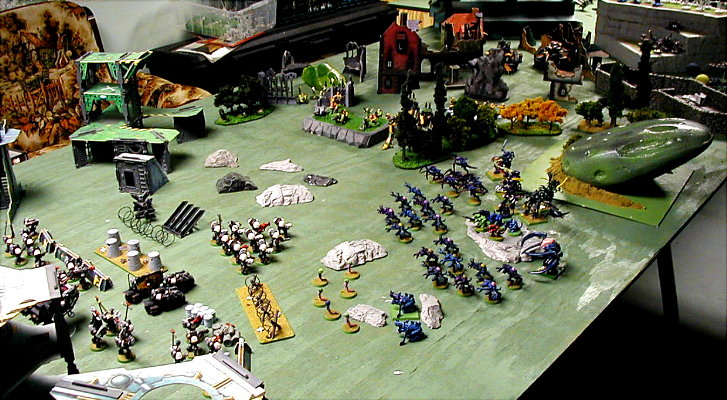
At first, I was a frequent customer of FLGS #1. The guys there seemed nice enough. The owner (we'll call him "J") always went out of his way to ask me questions about what I was playing or to tell me about the games that he was playing. If I had a prototype to work on, he always seemed genuinely interested. Even then however, it was obvious that his allegiances lay with the miniature players (Specifically Warhammer 40K) and CCG players (Magic, YuGiOh, Pokemon, etc), as game nights at FLGS #1 were dedicated to one or the other from 6pm on, M-F. As I started to gather more intel, it became blatantly clear that J, and his main employee "Z," had little to no knowledge about the games they were selling unless they were one of the 2 aforementioned genres. To make matters worse, the shop was becoming plagued with miniature players and magic enthusiasts. And not the cool M:tG players who can relate the strategy of their game to gaming as a whole. No, I'm talking about the M:tG players who think flipping a Delver of Secrets from one side to the other is tantamount to Oppenheimer discovering the secrets of the Atom Bomb.

This is my general emotional state after visiting one of the two FLGSes in my area.
This is not to say that Miniature players or people who enjoy M:tG are intolerable people. Not at all. Some of my best friends in the gaming world play Warhammer, HeroQuest, MageKnight, etc. Likewise, the minds of some people who design or play high level Magic are just fascinating to me: Zach Hill, Mark Rosewater, LSV, etc. I simply meant to say that the people who play these games at my FLGSes are intolerable. They're intolerable because the vast majority of them refuse to step out of their comfort zone and try, literally, ANY other genre of game. And before you say anything: yes, I have done my due diligence. I have brought games for them to try: Small World, Summoner Wars, Dominion, EmDo, Dominion, etc. I have played their games: Magic, Warhammer, D&D, in hopes of building a rapport. Maybe 1 out of 10 people with whom I interact actually plays a game with me. They typically enjoy the experience, but then go right back to playing a mini or CCG after the games conclude.

Look, I get it. Many online retailers have warehouses in which to store their product(s). This means they can hoc their wares at a lower price (though, with shipping, it usually evens out). Because of this, FLGSes are under more pressure to make money. So, they tend to pander to the types of games that will make them more money. This, I assume, means more reliance on sales from Miniatures and CCGs due to their price points and frequent rolling out of new material. From time to time, they might also stock something seen on Tabletop, because ya know... people are sheep; and if Wil Wheaton says a game is worthwhile, it must be worth spending money on.

But what responsibility, if any, does an FLGS have to diversify the tastes of the people who frequent it? Sure, all FLGSes are business. Businesses need to make money to stay in business so they can have an opportunity to diversify the tastes of their clientele, but to me,  the G in FLGS is indicative of a broad array of possibility. We don't call them FLWSes or FLCCGSes for a reason.  There is a world of games out there to be tried: Party games, Euro games, Ameritrash games, DBGs, Abstracts, etc.

I'm not asking the Mini players or the CCG enthusiasts to give up their normal fare, I'm simply asking them to try something new on the off chance that they might find a game they like or play a game whose strategies can be employed in their game of choice. Additionally, I'm not asking FLGS owners to completely scrap their normal schedule of high-grossing events. I just think it would behoove them to have ONE night a week where variety is encouraged. And, by variety, I mean THEM...actively getting out from behind the counter and playing games with their customers, getting to know the people who come into their stores, and getting to know the product they sell. I don't think that's asking too much.

  • Digg
  • Del.icio.us
  • StumbleUpon
  • Reddit
  • RSS

Don't drown in the hype...

Lords of Waterdeep is the newest in a line of Dungeons & Dragons themed games released by Wizards of the Coast.  The three previous games in the line were large box, miniature-heavy, dungeon crawlers very much in the vein of the original source material.  Lords of Waterdeep also mines the D&D mythos, but in a much different way.  Waterdeep tries to shoehorn all of the action of a D&D campaign into a European style worker placement game.  Waterdeep is very successful at being a Euro, but falls pretty flat at being a Dungeons & Dragons game.

For the record,  I am not a Dungeons & Dragons player.  I attempted one game and it went something like this:

DM: "You walk into this village, the townsfolk move in on you inquisitively.  The leader walks towards you with both arms raised above his head."

Me: "I slice the leader in half, and begin torching the village."

DM: "..."

*10 minutes later*

DM: "OK, all the villagers are dead, the town is ablaze..."

Me: "Awesome, I run back to the beach and steal their boat, and sail off for the treasure island."

DM: "Which direction is the treasure island?"

Me: "Uhhhh....left? I guess I should have looked for a map or something, huh?"

DM: *Sighs, closes notebook, grabs Star Trek CCG deck*  "You seed first, ok?"

Thankfully, you don't really need to know the Dungeon & Dragons brand at all to enjoy Lords of Waterdeep.  In Waterdeep, you play as one of the titular lords; these lords each give some sort of endgame bonus, and can help in directing your strategy as you play.  For example, the lord I played as in my first game gave a 4 point bonus for each Arcana and Warfare quest I completed.

As this is a worker placement game, you can expect that a game turn is pretty simple.  Each player starts the game with two workers...er, "Agents." You will gain a third after four turns.  When it is your turn, you place one agent onto a building and take the benefit of that building.  The board is laid out very well, there is a logical and clearly marked place for each building and card deck in the game.  The illustration on the board is supposed to be Waterdeep, but it looks more like a finished Carcassonne map to me.

The inn is probably the most important building in the game.  As you may suspect in a game themed from role-playing material, the inn is where you can gain more quests.  Since finishing quests is the way to gain points, you'll be visiting the inn quite often.  Each quest requires a number of adventurers to complete, so several of the other buildings on the board are various "adventurer's clubs" where you collect the appropriate people to take along with you.  You may also choose to go first in future turns, get some gold, draw an intrigue card (which may harm the other players), or even build a new building from the Building Hall.  These extra buildings are more powerful than the base buildings.  Unfortunately (for you) they are usable by all players; however, you will gain a small benefit if an opponent uses your building.

Poor attempt at a painfully artistic board shot
Overall, Lords of Waterdeep does the Euro thing extremely well.  Lords of Waterdeep is definitely a light-middle weight game.  There aren't many tricks up this game's sleeves.  The only gotcha moments come from the Intrigue cards.  These are pretty standard "take-that" cards that can help slow your opponents down.  All of this makes Waterdeep a great gateway game into the Euro / Worker Placement world. Where the game fails, for me at least, is in bringing the Dungeons & Dragons theme to the forefront.

As I said before, I'm not a D&D player (or a role-player of any type, to be honest), so I came into the game fearing that I would not "get" what was really going on.  However, that was not an issue at all.  In fact, since I was taught the game, I had no idea what most of the stuff I did actually meant in the world of D&D until I went back and read the rules myself.  Sure, your lords all have funny names, and the quests have text that tells you what your quest is all about, but none of that affects the game in the slightest.  It could have just as easily been a trading in the Mediterranean game.

With that being said, I did enjoy Lords of Waterdeep for what it is.  It is a beginner's Euro.  It's a great gateway game both for new game players, and for people looking to branch out from the role playing world by trying something with a comfortable theme.  Lords of Waterdeep is a fun game, but ultimately not one that I would add to my collection;  because I already have other games that do what this game does, but better such as Stone Age, Agricola, and even Leonardo da Vinci (a game I am more fond of than many, it seems)..


  • Digg
  • Del.icio.us
  • StumbleUpon
  • Reddit
  • RSS

Just like Camping, these games are "in tents."


Camping.  We've all done it at one time or another.  Whether it's sitting around a campfire telling ghost stories and eating s'mores in your backyard, or whatever these guys are doing...


we have all had that glorious feeling of being at one with nature.  Interestingly enough, in recent months several games have hit my personal radar with some aspect of camping as a theme.  This time, we are going to take a quick look at three of them: Scavengers, Let's Take A Hike, and Bears!
=======================================================

Scavengers by Zombie State Games


In Scavengers, each player has a set of four food cards (Chili Dog, Omelet, Kabob, and S'mores).  Players then play animal cards to one of three campsites in an effort to gain control of said campsite, which allows you to steal all the food carelessly left out.  Most of the animals have some sort of special ability as well.  Some of the abilities let you steal food bits out of turn, they might restrict which animals may be played at that camp for the rest of the round, or even move food from one camp to another.  The goal of the game is to collect the specific food bits required on your food cards.  The first player to complete all four cards wins.

Scavengers reminds me of a family friendly version of Blood Bowl: Team Manager.  The mechanics of playing cards in order to gain control of a specific camp in Scavengers is almost exactly the same as battling over a highlight in Blood Bowl.  One issue I do have with the game is that many of the cards, and the rule book itself are extremely text heavy.  It may be overwhelming, if not downright intimidating, at first glance for new players.  Fortunately, most of the abilities, and the rules, are pretty easily understood after one read through. 

Scavengers says it plays 2-4 players.  I found my 2-player game to be too dry.  This game lives on chaos, and there's not enough of that in a 2-player game.  I've played it a couple times with 3 players, and have found that to be a fairly good number.  Four player games tend to be extremely chaotic...you have to know your group to see if that little control is acceptable.  I rather like that lack of control here because it's not a game meant to be taken seriously, but it can cause the game to overstay its welcome for some.  
===============================================================

Let's Take A Hike by StrataMax Games


Ok, ok... hiking isn't camping.  I know, but one sometimes leads to the other, so I'm lumping this in.  Let's Take a Hike is a push your luck style card game in the vein of Cloud 9, Diamant, and Incan Gold.  2 to 5 players will be dealt a hand of cards.  The goal of the game is to score as many points as possible on a series of hikes.

These cards depict items you may want to bring along for a long hike such as a sleeping bag, socks, flashlights etc.  On your turn, you will be placing these items into an invisible backpack which resides on the table in front of you.  Each card has a small icon which shows you exactly where they can go in your pack.  After a few turns, someone will declare they want to go for a hike.  Each other player determines if they want to go along.  

At this point, the lead hiker (the player that started the hike) will flip over a card from the deck. If any of the hikers has that exact card in their pack, they are fine.  If a hiker does not have that card, they must discard a card showing the number of boot prints on the flipped card.  At this point, hikers decide whether they are dropping out of the hike, or carrying on.  If a hiker drops, they get to take a card from the flipped stack as a prize.  If the hike gets to a point where there is just one hiker left, when that hiker drops out, he or she gets all remaining cards in the prize pile.  Be careful though!  If you are ever caught without the ability to discard enough boot icons, or are hit by a hazard you cannot deal with, you are sent home with NOTHING!  The winner is the person with the most boot prints in their prize pile when the card deck is exhausted.

Of the three games I'm reviewing here, this one is my favorite.  I think building the pack generates a few interesting choices (although picking the right items mainly comes down to luck).  I especially love the artwork on the cards. The art has a retro style to it that I find extremely charming.  Let's Take a Hike is a cute game that kids of all ages should find enjoyable.
===================================

Bears! by Fireside Games


So, you've hiked all the way to the campsite, you've put the tent up, and suddenly the growl of a bear rises up behind you.  What do you do?  You can run, you can pull out your gun and shoot the bear, or you can just ignore the whole thing and sleep through the attack in your tent.  Those are the choices available to you in this fast paced dice game.

Each player is given five black player dice.  Each of these dice contain icons of a gun, a running person, or a sleeping person.  In the center of the table are a set of white "camp" dice.  There are five of these dice for each player as well.  Each of these dice have just two icons, bears and tents.  When players are ready, all of the camp dice are rolled.  At this point the players roll their dice, and the fun begins!  Players are quickly trying to match up their player dice with camp dice in an effort to score points.  

There are only three legal pairs that can be made in the game.  First, players can match a gun and a bear for 1 point.  Second, you can flee the scene by matching a tent and a runner die...this nets you 2 points.  Or, you can be brave (stupid) and match a tent with a sleeping bag.  If you make this match, and all of the bears that were rolled are taken down, you score a whopping 5 points.  However, if you try to sleep through the attack, and the round ends with even 1 bear alive...you lose 2 points.  Players are allowed to re-roll their player dice as many times as they want, but the round ends immediately once either all the bears or all the tents are gone from the camp dice pool.  As the rules are written, the first player to 100 points wins.

I put that last line in because, though fun, Bears is a game I need to play in smaller doses. I tend to play games to 50 points.  I don't do this because I dislike the game, but simply because speed games fluster me, and I don't enjoy that feeling for longer than a few minutes.  I'm sure there are people out there willing to play this game to 500 points, and are grandly disappointed when someone hits that goal.  I'm not one of those people.  

I want to lodge one complaint against Bears!  It's minor, almost to the point of being silly.  But when I bought the game, I assumed, based on the size and shape of the box, that there was a dice cup included.  It's not necessary, I mean, the box lid is close enough that I use it to roll all the camp dice.  I just felt a little let down when I opened the box, and there was no dice cup.

I hope you've enjoyed this look at three recent games related to the theme of camping.  If there are any other themes, or a series of games you'd like to see an article of this style about, please email us at gamesandgrub(at)@gmail.com, and we'll see what we can do!


  • Digg
  • Del.icio.us
  • StumbleUpon
  • Reddit
  • RSS